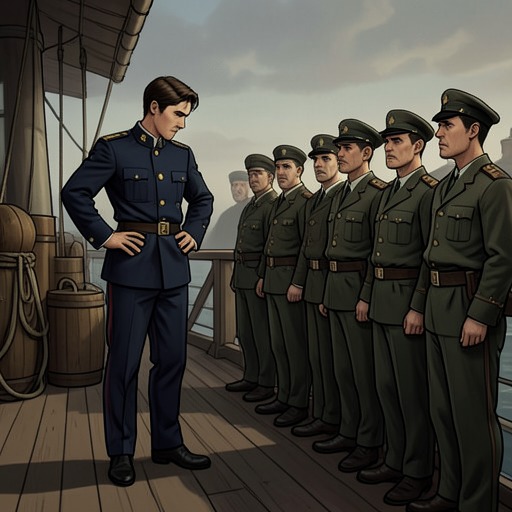
Edwin Keggs
The Caine MutinyEdwin Keggs is a midshipman at Furnald Hall Midshipmen School whose progress depends less on effortless academic command than on sustained work and practical skill. Initially worried that he might fail out, he proves dependable in quizzes, contributes strong navigation and engineering paperwork to his classmates, and receives orders to report to San Francisco for transportation to USS Moulton (DMS-21). The assignment turns his anxious expectation of being sent to mine-disposal training into startled relief at the prospect of serving aboard a ship.
Identity and Introduction
Keggs enters the story as a roommate of Willie Keith in the midshipmen school. Their first exchange is direct and unceremonious: Keggs introduces himself, learns Willie’s name, and recognizes that they will share a room. The pairing places him within a small group of classmates whose differing strengths become visible as they prepare for the demands of naval training.
His early concern is the school’s elimination system. The men are told that, after three weeks as apprentice seamen, the upper two-thirds of the class will become midshipmen while the rest will be sent to the United States Army. Keggs is uncertain about the technical language in his Naval Ordnance book and asks basic questions about its terminology. His apprehension is not presented as a lack of effort; rather, it establishes the gap between the knowledge the course demands and what he can readily grasp.
Study and Practical Strengths
As Bilging Day approaches, Keggs builds his standing through work that is careful, useful, and visible. He is strong in the paperwork of navigation and engineering. His plotting charts and boiler sketches are particularly accomplished, and he willingly lends those abilities to the others in the room. The detail matters because his contribution is not confined to his own prospects: classmates can make use of the work he does well.
The account also distinguishes practical competence from speed of comprehension. Keggs is slow to grasp facts and theories, so he sets an alarm for two hours before reveille and gives himself additional time to study. His appearance grows increasingly drawn as the deadline nears, but he does not miss a quiz. The pattern links his reliability to deliberate effort: where another student might rely on quick understanding, Keggs compensates by beginning earlier and persisting.
That effort does not make him an effortless scholar. His initial confusion about the ordnance text remains part of the portrait, even as his record improves. The contrast gives his success its particular shape: he is neither shown mastering every subject nor simply failing at the work. He has identifiable weaknesses, but also a steady capacity to meet the next test through preparation, and a technical skill set that helps his peers.
Choosing a Naval Assignment
When the midshipmen are asked to rank their preferred duties, Keggs struggles to complete the form. After agonizing over the blank sheet, he fills it in with a shaking hand. His first choice is Mine Disposal Training, a posting so unpopular that no other man at the school dares to list it. Submarines in the Pacific is his second choice; in small letters, he places Local Defense in the Atlantic third, identifying it as his actual preference.
The list preserves a distinction between the choice Keggs is prepared to make publicly and the duty he most wants. The narrative supplies no explanation for why he selects mine disposal first, so his motives remain unstated. What it does show is his hesitation as he makes the choices and the contrast between the formidable first preference and the local-defense assignment he privately favors. Unlike the more confident men, he does not treat the form as an easy declaration of a settled ambition.
Orders and Significance
When orders are distributed, Willie Keith’s are delayed, while Keggs receives an envelope. He trembles and cannot bring himself to open it. Willie anxiously asks what assignment he has drawn, and another classmate opens the envelope for him. The order directs Keggs to report to San Francisco for transportation to USS Moulton (DMS-21). Rather than the Mine Disposal Training he had placed first, he has been assigned to a ship.
The news changes his response at once. Keggs sits up and checks that the order really means a ship rather than mine-disposal training; when that is confirmed, he asks what a DMS is. His relief is clear, but the question also shows how little the assignment’s practical meaning has yet been explained to him. The scene ends with the orders establishing where he is to report and the kind of posting he has received, not with an account of his later service aboard USS Moulton.
Keggs’s brief arc is therefore shaped by uncertainty answered in stages: first the fear of being eliminated, then the sustained work that keeps him passing, and finally the suspense of the unopened envelope. His strengths are concrete and communal, particularly his navigation and engineering work, while his weaknesses are met with extra study rather than a sudden transformation into a naturally gifted student. The ship assignment provides a clear outcome to his schoolroom anxiety, but the text leaves the next chapter of his naval career outside this account.